
The Coherence Trap: Why Your "Authentic Self" Might Be Your Most Elaborate Fiction
Why the demand to be consistent might be the most violent thing you do to yourself

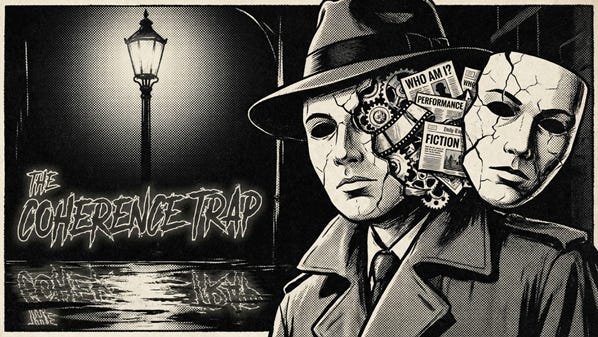
We’re told to “be ourselves.” To “find our authentic self.” To strip away the masks and reveal the true person beneath. It’s the dominant narrative of personal development, therapeutic practice, and contemporary wisdom about living well.
There’s just one problem: the unified, coherent, authentic self these narratives assume might be the most elaborate fiction we tell ourselves.
What if the search for your “true self” is precisely what prevents you from inhabiting the fragmented, contradictory, perpetually unfinished reality of what you actually are?
The Archaeological Delusion
Western culture teaches us to think about identity archaeologically. Somewhere beneath the layers of socialisation, expectation, trauma, and performance lies your true self, the authentic core that was always there, waiting to be excavated.
This model permeates therapy (”let’s uncover who you really are”), self-help (”discover your purpose”), and popular psychology (”your authentic self holds the key”). It’s intuitively compelling. The confusion, contradiction, and fragmentation we experience are surface phenomena. Dig deep enough, and you’ll find bedrock.
Except: no branch of psychology, neuroscience, or philosophy has found this bedrock. What we find instead, the deeper we look, is more complexity, more multiplicity, more context-dependent variation. The archaeological model keeps promising discovery whilst delivering deeper confusion.
Perhaps it’s because there’s no bedrock to find.
The Narrative Engine
Dan McAdams describes identity as an “internalised and evolving life story.” Not a discovery but a construction. We create coherent narratives from the messy, contradictory data of lived experience, and those narratives become our sense of who we are.
You tell someone about your career trajectory, and in the telling, you impose coherence that didn’t exist in the living. The job you took because you needed money becomes “a strategic move to develop client-facing skills.” The relationship that ended messily becomes “an important learning experience.” The identity crisis becomes “finding myself.”
We’re not lying. We’re narrativising. Creating stories that make sense of experiences that, in the moment, were ambiguous, contradictory, or simply chaotic. These stories are necessary, we need them to function, to explain ourselves to others, to maintain continuity across time.
But then we mistake the narrative for the reality. We confuse the story we told about our lives with what actually happened. The narrative becomes reified, turned into a thing, an object, a discoverable truth rather than a perpetually revised fiction.
And once reified, the narrative constrains. You can’t pursue that opportunity because “that’s not who I am.” You can’t admit that attraction because “I’ve always been someone who values stability.” You can’t acknowledge that desire because it contradicts the story you’ve constructed about what matters to you.
The authentic self you’ve worked so hard to discover becomes a prison.
Multiple Drafts, No Final Version
Daniel Dennett’s “multiple drafts model” describes consciousness not as a unified stream but as multiple parallel processes, each generating interpretations of incoming information. There’s no central “you” observing these processes. The sense of unified consciousness is itself one of the interpretations and not always the most accurate one.
Applied to identity: you’re not a single self with multiple facets. You’re multiple processes that sometimes create the experience of being a unified self, and sometimes don’t bother.
The “you” at work isn’t a partial expression of a deeper true self. It’s a context-specific configuration of processes that’s as real as any other configuration. The “you” with friends, with family, alone, these aren’t masks over authenticity. They’re different real configurations of what you are.
This explains why we can hold genuinely contradictory values, desires, and beliefs without experiencing constant cognitive dissonance. It’s not that one is authentic and others are compromises. It’s that different processes are dominant in different contexts, and the demand for overall coherence is something we impose after the fact.
The Social Weave
Identity isn’t just internally constructed, it’s socially negotiated. Who you are emerges in the interaction between your self-narrative and how others perceive and respond to you.
Erving Goffman called this “impression management.” We present versions of ourselves, others respond, and our sense of identity forms in that interactive space. Not deliberately manipulative (though it can be), just fundamentally social. You become the person others consistently treat you as being.
This creates a peculiar bind: the quest for authenticity, for the self that exists independent of social influence, may be the quest for something that cannot, in principle, exist. We’re irreducibly social. Our sense of self forms in relationship. The “true self” that exists prior to or independent of social context is a philosophical abstraction, not a psychological reality.
But if we’re socially constructed, doesn’t that mean we’re fake? That the “real” us is being suppressed?
Only if you’re still attached to the archaeological model. If identity is performative, not in the sense of being fake, but in the sense of being enacted rather than discovered, then social construction isn’t the suppression of authenticity. It’s how authenticity happens.
You’re not performing a self that differs from your true self. You’re performing selves, plural, and they’re all real.
Bad Faith and Radical Freedom
Sartre cut to the heart of this with the concept of “bad faith” self-deception about our own freedom. We tell ourselves we have to be a certain way because of our history, our personality, our identity. But Sartre insists: we’re radically free. The “self” we claim constrains us is something we’re continuously choosing to be.
Radical freedom means radical responsibility. You can’t blame your authentic self for your choices. There is no authentic self, there’s just you, choosing, moment by moment, with nothing deeper to appeal to.
The person who says “I can’t do that, it’s not who I am” is in bad faith. Not because they’re lying but because they’re treating their identity as a fixed fact rather than something they’re continuously creating. They’re using the idea of a true self to avoid the vertigo of freedom.
But we need some stability. Complete openness to continuous self-recreation is psychologically untenable. We need narratives, identities, coherent self-concepts. The existentialist demand that we acknowledge our freedom doesn’t eliminate our need for the structures we build from that freedom.
So we’re caught: the authentic self is a necessary fiction. Necessary because we can’t function without some coherent sense of who we are. Fiction because the coherence is imposed rather than discovered.
Living in the Fracture
Accept contradiction. You contain multitudes. The parts that don’t fit together don’t need to be integrated or resolved. You can value stability and crave disruption. You can be ambitious and content. You can want connection and need solitude. These aren’t signs of confusion, they’re signs of complexity.
The different “yous” in different contexts aren’t levels of authenticity. They’re different configurations, each real in its context. Stop trying to determine which is “really” you.
The vertigo of not knowing who you are isn’t a problem to solve, it’s the actual condition of being human. The people who seem to have figured themselves out have just committed more fully to a particular narrative. That’s not inherently better.
You don’t have to be “the kind of person who” does something to do it. Act first, let identity follow. Or don’t. You can do things that don’t reflect any deeper truth about who you are. Sometimes doing is just doing.
Integrity Without Essence
If there’s no true self to be authentic to, what guides behaviour? What prevents us from becoming pure social chameleons, optimising impression management without any core?
Integrity as coherence-in-time. You don’t need a unified self to maintain commitments across time. You need practices that create continuity even as you change. Keeping promises isn’t about being “someone who keeps promises” it’s about recognising that your past self made an agreement your present self will honour because that’s how trust works.
Responsibility without essence. You’re radically responsible for what you choose, but there’s no deeper self doing the choosing. You don’t get to say “that wasn’t the real me” when you do something you regret. It was you. Just not a unified, essential you, a contextual, provisional you who made that choice.
This is actually more demanding than the unified self model. You can’t appeal to your authentic nature to justify or excuse. You can only acknowledge: I did that. I am someone who has done that. And now I choose what to do next.
The Freedom You Didn’t Want
Most of us don’t actually want the freedom that comes with recognising identity as fiction. We want the search for our true self because it promises an answer. Discover who you really are, and then you’ll know what to do, how to live, what matters.
Accepting that there is no true self to discover means accepting that there are no answers buried in your psyche waiting to be found. No authentic core that will tell you whether to take the job, end the relationship, move to the new city. Just you, with your contradictions and uncertainties, having to decide without the comfort of believing you’re discovering rather than creating.
The promise of authenticity is that it will end the search. Find yourself, be yourself, and the questions resolve. But the search for a unified authentic self generates the fragmentation it claims to solve. The more you look for the coherent core, the more you notice all the ways you don’t cohere. The more you try to be “authentically you,” the more you create a performance of authenticity that feels just as constrained as whatever you were trying to escape.
All the Way Down
What if all the way down, it’s masks? Not in the sense of falseness, in the sense that the self is performative, enacted, constructed moment by moment in response to context and relationship and accident.
You’re not hiding your authentic self. You’re continuously creating provisional selves, none more real than others, all serving different functions, all genuinely you whilst none is definitively you.
The fractured self isn’t a problem to solve. It’s the human condition to inhabit.
Who are you beneath the mask?
Nobody in particular. Everyone you’ve ever been. Someone different tomorrow.
The question isn’t who you really are. The question is who you’re becoming, moment by moment, in the continuous performance of being alive.